

Calm in the Water: A Swim Instructor Guide for Sensory Sensitive Swimmers
Calm in the Water: A Swim Instructor Guide for Sensory Sensitive Swimmers
Couldn't load pickup availability
🔒 Secure checkout 📱 Works on any device 💳 Apple Pay & Google Pay accepted
The guide that finally explains the child you can't quite reach
Written by a paediatric occupational therapist. Designed for swim instructors who work with children with autism, ADHD and sensory processing differences and want to do it better.
- 40 pages of practical, poolside ready guidance
- Covers autism, ADHD, sensory processing, behaviour, safety and progress tracking
- No jargon. No clinical training required. Immediately applicable
- Includes quick reference posters and a parent information form
- Created by a paediatric OT with clinical experience in neurodevelopmental differences
You've had this child in your class
The one who screams at the pool gate before anything has even been asked of them. The one who was calm last week and completely unreachable today. The one who cannot stop moving, cannot settle, disrupts the lesson and seems indifferent to every strategy you try. The one who shuts down mid-lesson and stares blankly while you repeat the same instruction a fourth time.
None of that is defiance. None of it is a parenting failure. And very little of it is within the child's conscious control.
What you are seeing is a nervous system doing the best it can with the load it is managing. When you understand that, everything about how you respond to these children changes.
This guide was written to give you that understanding and the practical tools to act on it, in the water, in real lessons, right now.
Standard instructor training doesn't cover this
Swim instructor qualifications teach you how to teach swimming. They do not teach you how the nervous system of a child with autism processes a pool environment before you've said a word. They don't explain why a child with ADHD jumps in before you finish the instruction every single time, without apparent awareness. They don't tell you what sensory seeking actually looks like, or why a rash vest can be the difference between a child who participates and one who refuses.
Without this knowledge
- Behaviour feels like defiance or lack of effort
- Repeating instructions that don't land
- Lessons derailed by one child's responses
- Progress stalls with no clear reason why
- Parents feel unsupported and misunderstood
- Safety risks go unrecognised
With this knowledge
- Behaviour becomes readable, not frustrating
- Instructions are structured to actually land
- Lessons run better for every child in the class
- Progress is tracked against the right things
- Parents become partners, not problems
- Safety is proactively managed, not reactive
15 chapters. Everything you actually need.
Each chapter is written specifically for swim instructors warm, practical, no clinical background required. This is not a textbook. It is a professional resource you can read once and use every lesson.
- Understanding the Sensory Pool Environment Why the pool is one of the most demanding sensory environments a child can encounter and what that means before you've said a word
- How Swimming Supports Neurodevelopment What is actually happening in the water for children with autism, ADHD and sensory differences and why your role is bigger than you think
- When the Learning Loop Breaks Down Why standard teaching approaches fail for these children, and a clear framework for diagnosing exactly where things go wrong
- Being an Effective Teacher for Every Child Trust, consistency, communication and behaviour what each of these means specifically when you are working with neurodivergent learners
- Autism and the Pool What autism actually is, what it looks like in the water, and what works practically and immediately
- ADHD in the Water Why the child who jumps in early is not being difficult, and the specific strategies that work with the ADHD brain rather than against it
- Sensory Processing Disorder Seekers and Avoiders The two profiles you will encounter most often, what each needs, and how to tell them apart at a glance
- Adapting Your Teaching for Sensory Needs Routine, instructions, tone, the regulation window practical adjustments that change the experience for sensory sensitive children immediately
- Water Familiarisation and the Sensory Nervous System Why standard familiarisation timelines do not apply, and how to pace exposure so progress actually sticks
- Practical Activities in the Pool The OT lens on activities you already run what bubble blowing, kicking and retrieval activities are actually doing neurologically, and how to sequence them deliberately
- Partnering with Parents What to ask before lessons start, how to give feedback that actually helps, and when to refer to an OT
- Safety, Risk Awareness and Impulse Control The specific safety risks autistic and ADHD children carry near water and how to manage them proactively, not reactively
- Tracking Progress the Right Way The three layers of progress most instructors miss, and a simple framework for observing and communicating what is actually happening
- Building Your Inclusive Practice What it looks like when everything in this guide becomes habit and how that raises the quality of teaching for every child in your classes
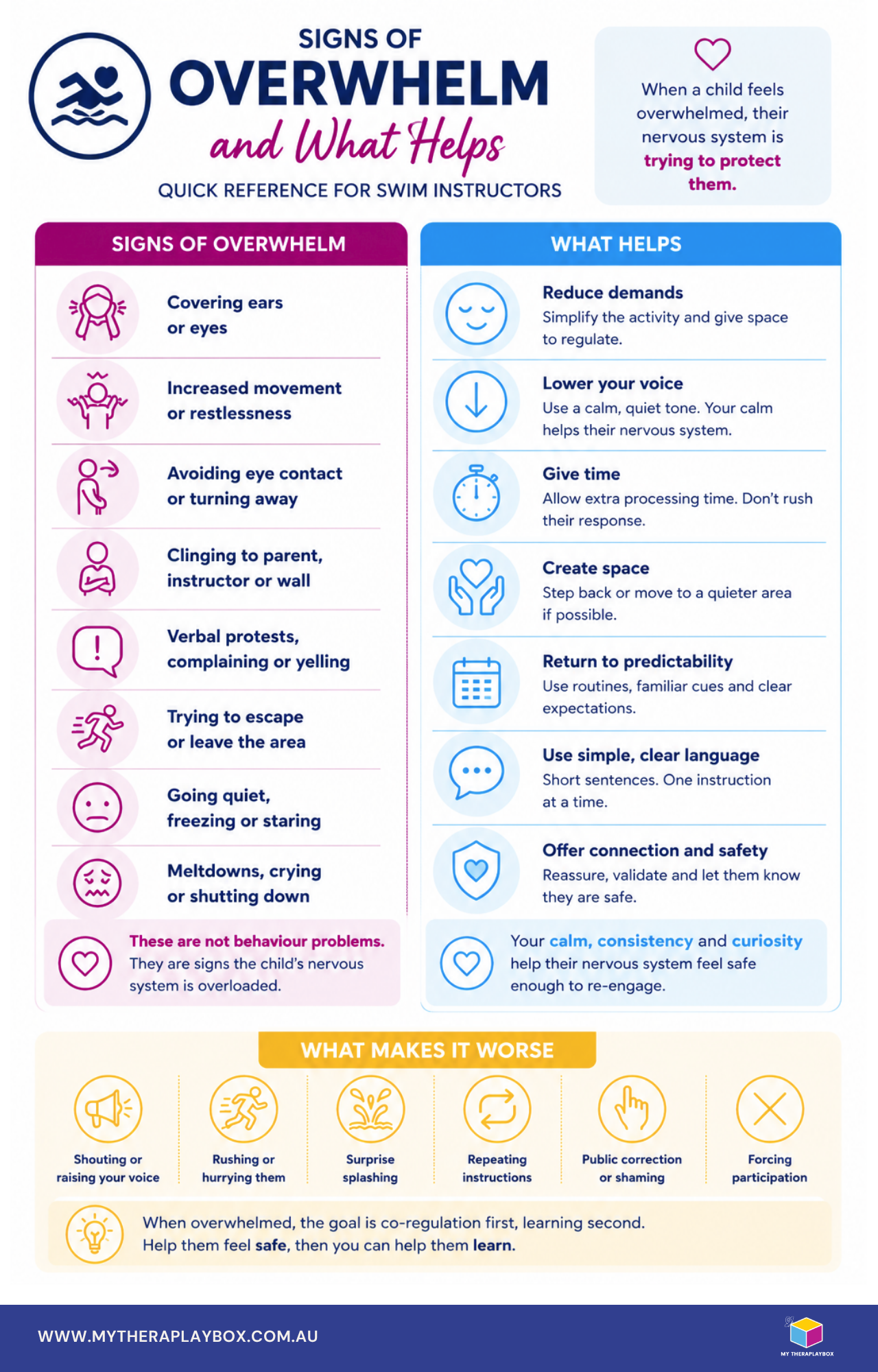
- Closing Note + Practical Resources Quick reference posters, a behaviour through a sensory lens guide, signs of overwhelm, small wins tracker, and a parent information form ready to print and use
A note on water safety: Autistic children are significantly overrepresented in drowning statistics. The combination of sensory draw to water and reduced capacity to assess risk in the moment creates a specific and serious risk profile. Understanding this changes how you approach safety teaching with this group not as a special accommodation, but as a professional responsibility built into every lesson.
The guide plus everything you'll use poolside
Single instructor or whole team?
Single instructor licence
One instructor, one facility. Full guide plus all resources included.
Swim school team licence (up to 10 instructors)
Share with your whole teaching team. One purchase, one facility. Ideal for swim school owners who want consistent, informed practice across every instructor.
To purchase a facility licence email us at Email support@mytheraplaybox.com.au
Built on clinical practice, not theory
This guide was written by paediatric Occupational Therapists of EquipKids Occupational Therapy in Melbourne. The clinical reasoning behind every strategy in this guide comes from direct practice with children with autism, ADHD and sensory processing differences and their families.
It is not a repackaged general resource. It was written for swim instructors specifically because the pool environment makes unique demands on sensory sensitive children, and because the instructors working with these children deserve a resource that understands that.
The parent bundle that works alongside this guide Thrive in the Water is available at mytheraplaybox.com.au/swimming. Sharing it with families gives parents the tools to support your work between lessons.
What instructors usually ask before purchasing
The child you can't quite reach is in almost every class. Now you'll know what to do.
This guide won't change what these children need. It will change whether you know how to meet them there. That is a skill worth having.
Get the guideInstant download · PDF · Single instructor licence · Team pricing available
Disclaimer: Calm in the Water is a professional education resource designed to support swim instructors working with children with autism, ADHD and sensory processing differences. It is not a substitute for formal qualifications, individual clinical assessment or professional supervision. The strategies and information provided are general in nature and may not be appropriate for every child or context. For children with complex needs, referral to a paediatric occupational therapist is recommended. This resource is intended to complement professional practice, not replace it.
Created by Paediatric Occupational Therapists at · EquipKids Occupational Therapy, Melbourne · mytheraplaybox.com.au
© 2025 MyTheraPlayBox. All rights reserved. Licensed for individual professional use.
Share